Online course · English
The Secrets of MIDI Programming
Make your virtual instruments — and your computer-based tracks — actually sound real.
Originally taught in French and translated to English with AI dubbing — you may notice occasional minor lip-sync or audio artifacts. The teaching content is unaffected.
Card, Apple Pay, Google Pay, PayPal or Klarna. Split it in instalments with Klarna or PayPal, at no extra cost.
−50% limited-time offer, applied automatically (code MIDI502026)
Secure checkout · Stripe & PayPal
By purchasing you agree to our Terms. 14-day money-back guarantee (if <20% completed).
What you'll learn
- ✓Program your MIDI so it sounds alive, not robotic
- ✓Master CC1 + CC11 (modulation & expression)
- ✓Adapt your programming to the type of sound (percussive vs. sustained)
- ✓Smart layering for a full, wide, professional sound
- ✓Quick diagnosis: why your mockups still sound flat
- ✓A workflow proven in production on Arte, TF1 and HBO Max
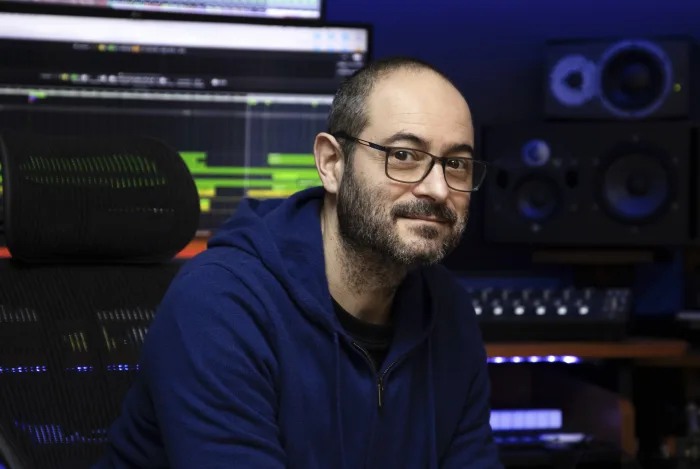
Who I am
Alexandre Lessertisseur — film & TV composer
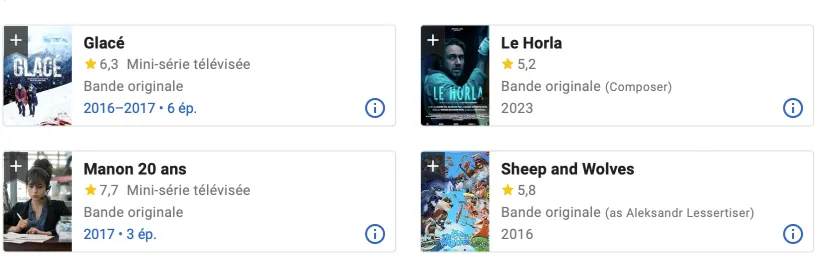
I've spent 15+ years scoring for film and television — the music behind 100+ TV series, including prime-time network broadcasts. My work has aired on HBO Max, BBC, ZDF, Globo, France Télévisions, TF1, Arte and Hulu — across feature films, series and documentaries.
This course distills the exact techniques that got me there — nothing theoretical, just what actually works on a professional deadline.
Best Original Music — Luchon Festival (2018 & 2023). Jerry Goldsmith Awards nomination (2016).
What students say
“I really came to understand how crucial layering and templates are to making my MIDI mockups sound real. The method helped me level up: I wrote a piece right after, applying the tips on strings to build atmosphere and texture. You can genuinely hear the track come alive as you stack the layers. Honestly, I was hooked.”

“I followed Secrets of MIDI Programming seriously and with real pleasure. In a practical, professional spirit, it gives you skills you can use immediately, the kind that change the face of your work. I had real trouble with quantization, with MIDI layers stacking on top of each other, with controllers like CC1 and CC11, without ever really naming the problem. This course made it click, and got me thinking about groove and transients across every style. It's an open, realistic, hands-on training. Unless you're regularly handed hours of real symphonic scoring, don't miss it, it can change a lot of things in your life.”
“I used to struggle to make my mockups believable, my double bass, drums, even piano never quite convinced. MIDI programming is what finally let me sound real and big, and that's really the heart of the craft. If you're on the fence, I'd just say: learn to program, so it sounds real.”
“My mockups from Dorico and Sibelius always came out flat. This course got me working straight on the piano roll instead of the score, bringing real life and expression through the main controllers, CC1, CC11, note lengths, the balance between lows and highs, plus how to use quantization on live takes in the DAW. The result: I'm more productive and I finish a track much faster.”
This course is for you if…
- →Your mockups still sound robotic despite good VSTs
- →You struggle to bring your melodic lines to life
- →You want a pro sound without paying for a studio every session
- →You compose (beginner or experienced) and want tangible results
14-day money-back guarantee
There's no risk in trying. If the course isn't right for you, I refund you up to 14 days after purchase — unless you've completed more than 20% of it, which is only fair.
Frequently asked questions
- How long does it take?
- You can do it in one intensive weekend or spread it over 2–3 weeks at your own pace. Access is for life.
- Which DAW do I need?
- The method is universal — it works with Cubase, Logic, Ableton, Studio One, Reaper and most modern DAWs. Examples are demonstrated in Cubase but fully transposable.
- Do I need MIDI experience?
- The technical basics are covered. You can follow even without prior MIDI-programming experience, as long as you have a DAW and a virtual instrument installed.